
Mehlo madala! It’s been a long time since there’s been a fresh discussion of izaga nesisho here, so I thought we’d talk about izinyoni.
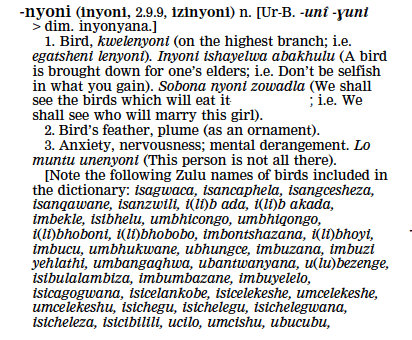
Inyoni is one of those isiZulu words that has a high variety of specific words underneath it (338 to be precise), much like utshwala, inja, ibutho and inyoka. The entry in my favourite lexicographic work (Doke and Vilakazi’s Bilingual isiZulu-English Dictionary) has inyoni as:
1. Bird
2. Bird’s feather, plume (as an ornament)
3. Anxiety, nervousness, mental derangement.
So that’s an interesting association – that izinyoni are things easily scared off, in a constant state of agitation. And if you say ‘Lo muntu unenyoni’, Vilakazi tells us that ‘this person is not all there’. Instead of saying ‘he’s a sandwich short of a picnic’, isiZulu says ‘he’s plus a bird’.
Already, izinyoni seem to be painted with a negative brush. So let’s look at the proverbs.
Elsewhere, I looked at ‘Isisu somhambi asingakanani, singangenso yenyoni’, where the emphasis is that inso yenyoni is tiny. So birds are small.
Then there’s ‘inyoni ishayelwa abakhulu’, which Vilakazi translates as ‘a bird is brought down for one’s elders’, meaning ‘do not be selfish in what you gain’. Birds are prey to humans, and they are prized for their food. So a bird is a reward, a promotion or gain – and it is only appropriate that the rewards each of us reap are given in thanks to our elders. This is a proverb about not forgetting who it was that got you where you are today.
There’s also ‘sobona nyoni zowadla’, which is far more idiomatic. The fullest grammatical version of this sentence would be ‘siyobona ukuthi yiziphi izinyoni ezizowadla [amabhele]’, which is ‘we will in the remote future see which of the birds it is that will eat the sorghum’. Vilakazi translates this as ‘we shall see who shall marry this girl’. Of course, the pun on amabhele and amabhele is transparent here. A crude translation would be ‘we’ll see which birds will peck those tits’. Birds are men, and women have amabhele that are eaten by birds.
Nyembezi’s ‘Zulu Proverbs’ contains 13 that directly mention izinyoni:
isisu somhambi asingakanani, singangenso yenyoni bird = small
sobona nyoni zowadla birds = eligible bachelors
ukuz’ ubon’ inyon’ ihluthuk’ isisila? bird = miserable human
wanyiwa yinyoni bird = solitary / always kakking
inyon’ enkulu ingafa kubol’ amaqanda bird = head of family
uhlekwe zinyoni birds = haters
ziwadl’ ebhekile birds = thieves / tricksters
inyon’ ishayelw’ abakhulu bird = achievement / pride
inyoni kayikukhulunyelw’ eziko bird = secret stash / project
akukho nyon’ endiz’ ingahlali phansi bird = hardworking person
inyoni yinhle ngezimpaphe zayo bird = reputable person
inyoni kayiphumuli bird = rolling stone
inyoni ikhala kusile bird = cautious person
What do you think? What’s the general consensus on izinyoni in the proverbs of the amaZulu? Are there more proverbs missing from this list?
Next time I’ll look at the more specific birds – how is an inkankane perceived, as opposed to inqe or ukhozi? What about ijuba and inkonjane?
It’s all for (and about) the birds.

 uMabhengwane